
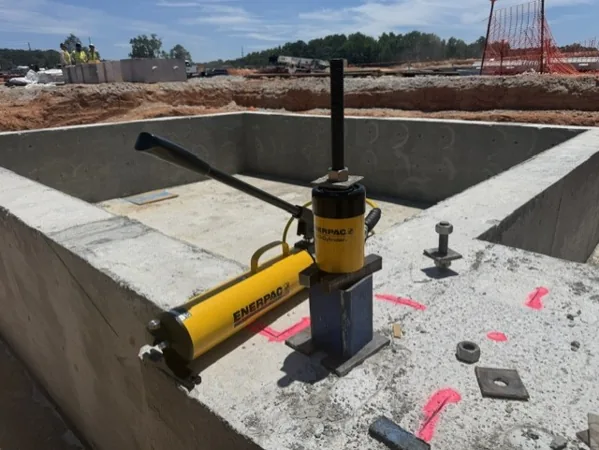
As of January 1, 2026, Georgia adopted the 2024 International Building Code with Georgia Amendments — jumping directly from IBC 2018 to IBC 2024 and skipping the 2021 edition entirely. This means Georgia contractors, engineers, and inspectors are encountering six years of code updates all at once. For anchor bolt testing specifically, this brings expanded post-installed anchor inspection scope, new minimum inspector qualification requirements, and the SEAOG Special Inspections Guidelines as an authorized reference standard.
The Georgia Department of Community Affairs (DCA) issued its notice of intent and received final approval from the DCA Board in August 2025. Grace periods for implementation are left to local jurisdictions, meaning project teams should prepare for a direct transition and coordinate closely with building officials for projects being permitted around the transition date.
Why the Jump from 2018 to 2024 Matters
Most states that adopted the 2024 IBC moved from the 2021 edition — a three-year update. Georgia jumped six years in a single step. If your team's last code reference was IBC 2018, you're not missing one cycle of changes — you're missing two. The 2021 IBC brought the initial alignment with ACI 318-19 provisions. The 2024 IBC expanded on those with refined special inspection scope, digital documentation recognition, and new provisions for metal building systems. Both sets of changes hit Georgia projects simultaneously.
Bottom Line for Project Teams
If you've been permitting projects under IBC 2018 and haven't reviewed the 2024 changes, your special inspection program likely needs updating. The Statement of Special Inspections, inspector qualifications, and testing scope for post-installed anchors have all been modified.
Key Changes Affecting Anchor Bolt Testing
1. SEAOG Special Inspections Guidelines — Georgia Amendment IBC-2024-14
Georgia added Section 1701.3 authorizing local building officials to use the ACEC/SEAOG SI GL 01-2024 Georgia Special Inspections Guidelines for implementing and enforcing Chapter 17 Special Inspections and Tests. This document provides detailed, Georgia-specific guidance on post-installed anchor testing procedures, preconstruction meeting requirements, inspector qualifications, and the scope of special inspection programs. Building officials can adopt these guidelines in part or in whole for their jurisdiction.
2. Minimum Special Inspector Qualifications — Georgia Amendment IBC-2024-15
Georgia added Table 1704.2 specifying minimum qualifications for special inspectors. This is new — IBC 2018 did not include a qualification table. For post-installed anchor testing specifically (Category C.3), inspectors must meet both an education/experience requirement and a certification requirement:
Education/Experience (meet at least one): High school or equivalent graduate with minimum 2 years verified relevant work experience, OR minimum 3 years verified relevant work experience without diploma.
Certification (meet at least one): ICC Reinforced Concrete Special Inspector, ACI Concrete Construction Special Inspector, ACI Concrete Field Testing Technician Grade 1, or ACI Post-Installed Concrete Anchor Installation Inspector.
This two-part requirement means the days of anyone with a pull test rig signing off on results are over in Georgia. Inspectors must hold both documented experience and a recognized certification.
3. Expanded Post-Installed Anchor Inspection Scope
IBC 2024 Chapter 17 expands the post-installed anchor inspection requirements. Specific requirements for special inspection must be included in the research report (ICC-ES ESR) for the anchor, issued by an approved source in accordance with ACI 318 Section 26.13. Where specific requirements are not provided in the ESR, the registered design professional must specify them and the building official must approve before work begins. This closes the gap that existed in IBC 2018 where anchors without detailed ESR testing provisions could proceed without clear inspection criteria.
4. Digital Statement of Special Inspections
IBC 2024 Section 1704 now explicitly recognizes digital Statements of Special Inspections. While many jurisdictions were already accepting digital documents, this formal recognition provides legal clarity for electronic submissions, digital signatures, and cloud-based inspection documentation. For anchor testing, this means test reports, load-displacement data, and inspection certifications can be submitted electronically with full code backing.
5. Coordination with ACI 318-19
IBC 2024 Table 1705.3 coordinates special inspection provisions for welding of reinforcing steel with the provisions in ACI 318-19 Section 26.13.3. For projects involving adhesive anchor dowels connecting to existing reinforcement, this coordination ensures the inspection requirements for the anchor installation and the rebar welding are aligned under a single framework.
What Didn't Change
The core anchor testing requirements from Table 1705.3 remain consistent in structure. The testing frequencies — 100% for structural, 50% for nonstructural, 25% for adhesive shear dowels, 10% for low-load anchors — carry forward from the 2018 edition. The confined vs. unconfined testing requirements remain the same. The 20-consecutive-pass failure protocol remains the same. The fundamental framework is unchanged — what changed is how it's implemented, who can perform it, and how it's documented.
What Your Project Team Should Do Now
Review the SEAOG Guidelines
Download and review the ACEC/SEAOG SI GL 01-2024 Georgia Special Inspections Guidelines. Check whether your local jurisdiction has adopted them. If so, your preconstruction meeting checklist and special inspection program must align with these guidelines.
Verify Inspector Qualifications
Confirm that your special inspector meets the minimum qualifications in new Table 1704.2. For post-installed anchor testing, ensure the inspector holds applicable ACI, ICC, or AWS certifications recognized by the building official in your jurisdiction.
Update Your Statement of Special Inspections
The Statement of Special Inspections for your project should reference IBC 2024 — not IBC 2018. If your SSI template hasn't been updated since January 2026, it needs revision. Ensure anchor testing scope, frequencies, and acceptance criteria are listed per the current code.
Check Your Anchor ESRs
The 2024 IBC requires specific special inspection requirements to be included in the anchor's ICC-ES Evaluation Report (ESR). If your specified anchor's ESR doesn't include inspection requirements, the registered design professional must specify them and the building official must approve before installation begins. Don't wait until the inspector shows up on site to discover this gap.
Coordinate with Your Building Official
Grace periods vary by jurisdiction. Confirm with the local building official whether your project falls under IBC 2018 or 2024. For projects permitted around the transition date, this coordination is critical — the code edition determines the inspection requirements, inspector qualifications, and documentation format.
References
Georgia DCA — Current State Minimum Codes for Construction
Official Georgia page listing all currently adopted codes including the 2024 IBC with Georgia Amendments.
Georgia DCA — 2024 IBC Task Force Amendment Chart
Complete list of Georgia amendments to the 2024 IBC, including Amendments IBC-2024-14 (SEAOG Guidelines) and IBC-2024-15 (Inspector Qualifications Table).
ACEC/SEAOG SI GL 01-2024 Georgia Special Inspections Guidelines
The Georgia-specific special inspections guidelines authorized for use by local building officials under Amendment IBC-2024-14.
IBC 2024 Chapter 17 — Special Inspections and Tests
The base IBC 2024 Chapter 17 provisions before Georgia amendments. Includes Table 1705.3 anchor testing requirements.
PES Structural Engineers — Georgia Building Code Changes 2026
Comprehensive overview of structural design impacts from Georgia's adoption of the 2024 IBC, including timeline and transition guidance.
Frequently Asked Questions
Need IBC 2024-Compliant Anchor Testing in Georgia?
We perform anchor bolt pull testing across Georgia under the new 2024 IBC requirements — with inspectors who meet the updated qualification standards. Atlanta, Savannah, Macon, Augusta, Athens, Columbus, and everywhere in between.
Request a Quote Call (404) 860-1288