
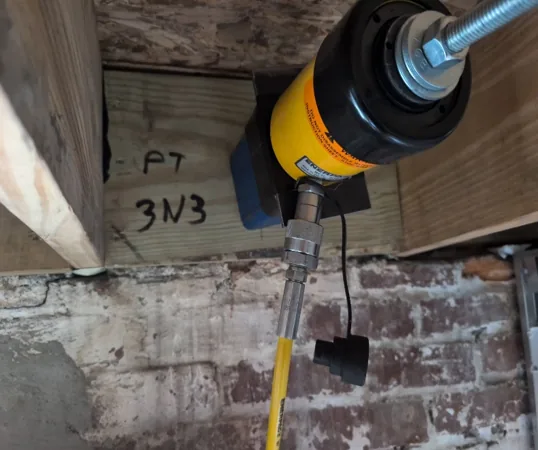
On July 10, 2006, 26 tons of concrete ceiling panels fell from their epoxy-anchored supports in Boston's Interstate 90 connector tunnel, killing passenger Milena Del Valle. The National Transportation Safety Board determined the probable cause was the use of an epoxy anchor adhesive with poor creep resistance — a fast-set formulation that could not sustain long-term loads. The collapse exposed failures in material selection, engineering oversight, and inspection protocols, and led directly to the anchor testing requirements that govern construction today.
What Happened
At approximately 11:00 PM on July 10, 2006, Angel and Milena Del Valle were driving eastbound through the I-90 connector tunnel in Boston on their way to Logan Airport. As they approached the D Street portal, a section of the tunnel's suspended concrete ceiling detached from the tunnel roof and fell onto their vehicle. The concrete panels — each weighing approximately 4,600 pounds — crushed the right side of the car. Milena Del Valle was killed. Angel Del Valle escaped with minor injuries.
A total of approximately 26 tons of concrete panels and suspension hardware fell onto the vehicle and the roadway. Twenty anchor bolts had pulled free from the tunnel ceiling. The ceiling panels had been supported by steel hangers anchored to the tunnel roof with adhesive anchors — bolts set in epoxy-filled holes drilled into the concrete.
The Root Cause: Epoxy Creep
The NTSB determined that the probable cause was the use of an epoxy anchor adhesive with poor creep resistance. Creep is the slow, time-dependent deformation of a material under constant load. Unlike a sudden failure, creep happens gradually — over months or years — as the material slowly stretches and fractures until the connection can no longer hold. The ceiling panels were a permanent dead load. The epoxy holding them up was slowly failing the entire time they were in place.
The product used was Powers Fasteners Power-Fast Fast Set epoxy — an amine-based fast-cure formulation. Powers Fasteners had conducted independent creep tests on their fast-set epoxy as early as 1995 and 1996, which demonstrated its unsuitability for sustained load applications. By 1999, the company had internally documented that fast-set epoxies did not meet elevated temperature creep requirements and were only recommended for short-term loading from seismic and wind events.
The standard-set version of the same product line had adequate creep resistance and could have been used. But the fast-set formulation was selected for the project without an engineering review of its long-term load characteristics. The distinction between fast-set and standard-set — and their dramatically different creep behavior — was not communicated clearly enough to prevent the substitution.
The Warning Signs That Were Ignored
The collapse did not come without warning. Anchor displacement was documented as early as 1999 — seven years before the fatal failure. Additional movement was recorded in 2001. These displacements were visible evidence that the epoxy was creeping under sustained load.
When the early anchor failures were discovered, engineers and project managers attributed the displacement to installation errors rather than a fundamental material problem. They did not investigate whether epoxy creep could be the cause. They did not continue monitoring the displaced anchors. The Massachusetts Turnpike Authority delayed implementing a required tunnel inspection program from November 2003 until July 2006 — the same month as the collapse.
The Critical Missed Opportunity
The NTSB concluded that had the MTA, Bechtel/Parsons Brinckerhoff, or Modern Continental investigated the 1999 anchor displacement as a potential creep failure rather than assuming it was an installation error, they likely would have discovered the problem and could have prevented the collapse. A monitoring program was available but never implemented.
Timeline of Failure
Powers Fasteners conducts internal creep tests showing fast-set epoxy is unsuitable for sustained loads.
Powers internally documents that all amine-based fast-set epoxies do not meet elevated temperature creep requirements. Five anchor bolts fail during testing in another tunnel section — the first visible warning sign.
Engineers attribute the displacement to installation errors. No investigation into epoxy creep as a potential cause.
Additional anchor displacement recorded. Monitoring is not continued.
Tunnel inspection program guidelines become available. MTA does not implement them.
At 11:00 PM, 26 tons of concrete ceiling panels fall in the D Street portal of the I-90 connector tunnel. Milena Del Valle is killed. Twenty epoxy anchors have pulled free from the tunnel roof.
NTSB releases its final report. Probable cause: epoxy adhesive with poor creep resistance. Contributing factors: failure to identify creep as a risk, failure to monitor known displacement, failure to implement inspection program.
Settlements total over $500 million: $458M with the State of Massachusetts, $16M with the City of Boston, $28M with the Del Valle family. Powers Fasteners ordered to revise product literature to clearly state fast-set limitations.
The Legal Consequences
The companies responsible for designing and building the tunnel faced both criminal and civil charges. The total financial consequences exceeded half a billion dollars.
Settlement with the State of Massachusetts in the criminal case — paid by Bechtel/Parsons Brinckerhoff, Modern Continental, and their insurers.
Settlement with the Del Valle family in the wrongful death and personal injury civil case.
Settlement with the City of Boston to resolve potential manslaughter charges against responsible parties.
How It Changed the Codes
The Big Dig collapse didn't just result in settlements — it fundamentally changed the way adhesive anchors are qualified, installed, and inspected across the United States. Every code change listed below is a direct consequence of one preventable failure in one tunnel on one night in Boston.
ACI 355.4 — Adhesive Anchor Qualification
Created specifically in response to the collapse. This standard establishes qualification requirements for post-installed adhesive anchors, including mandatory creep testing under sustained loads. No adhesive anchor product can be used in construction without passing the creep qualification in ACI 355.4. This standard did not exist before the Big Dig.
Certified Installer Requirement
ACI 318 Section 26.7.1(l) now requires that adhesive anchors in horizontal or upwardly inclined orientations resisting sustained tension loads must be installed by a certified installer through the ACI/CRSI Adhesive Anchor Installer Certification (AAIC) program. The overhead installation simulation has roughly a 50% failure rate — even among experienced installers.
Continuous Special Inspection
IBC now requires continuous special inspection — the inspector present during the entire installation — for adhesive anchors in horizontal or overhead orientations resisting sustained tension. Before the Big Dig, periodic inspection was sufficient for all anchor types.
Massachusetts Epoxy Anchor Ban
The Massachusetts Department of Transportation banned epoxy anchors in overhead applications entirely. The tunnel's ceiling anchors were replaced with Hilti mechanical undercut anchors — a system that relies on mechanical interlock with the concrete rather than adhesive bond, eliminating the creep risk.
Product Labeling Requirements
The NTSB ordered Powers Fasteners and Sika Corp to revise product literature and packaging to clearly state that fast-setting adhesives are approved for short-term loads only. Powers increased the safety factor on its fast-setting materials by a factor of four after the collapse.
The Lesson for Every Project
The Big Dig collapse was not caused by an exotic failure mode or an unforeseeable event. It was caused by using the wrong adhesive for the application — and then ignoring the warning signs for seven years. Every element of the chain could have been broken:
The adhesive could have been specified correctly. The creep risk could have been identified in design review. The 1999 anchor displacement could have been investigated as a material failure rather than dismissed as an installation error. A monitoring program could have been implemented at any point in the seven years between the first warning and the collapse.
This is why anchor testing requirements exist today. The codes, the inspection requirements, the qualified installer certifications, the creep testing in adhesive qualification programs — all of it traces back to this one failure. When an inspector requires pull testing on your project, this is the reason.
References & Further Reading
NTSB Highway Accident Report HAR-07/02
The complete NTSB investigation report on the I-90 connector tunnel ceiling collapse. Establishes the probable cause as epoxy adhesive with poor creep resistance and identifies contributing factors in design, construction, and oversight.
ACI 318 Chapter 17 & Section 26.7.1(l)
Anchor design provisions and the certified installer requirement for adhesive anchors in sustained tension — created in direct response to the collapse.
IBC 2024 Section 1705.3
Special inspection requirements for post-installed anchors, including continuous inspection for overhead adhesive anchors in sustained tension.
OSHA 1926.502(d)(15)
Fall protection anchor requirements — relevant to any overhead anchorage application similar to the Big Dig ceiling system.
Frequently Asked Questions
Anchor Testing Exists Because of This Failure
We perform IBC-compliant anchor bolt pull testing across the Southeast — the testing that exists because of lessons learned from the Big Dig. Calibrated Enerpac equipment, full documentation, and the credentials to back it up.
Request a Quote Call (404) 860-1288