
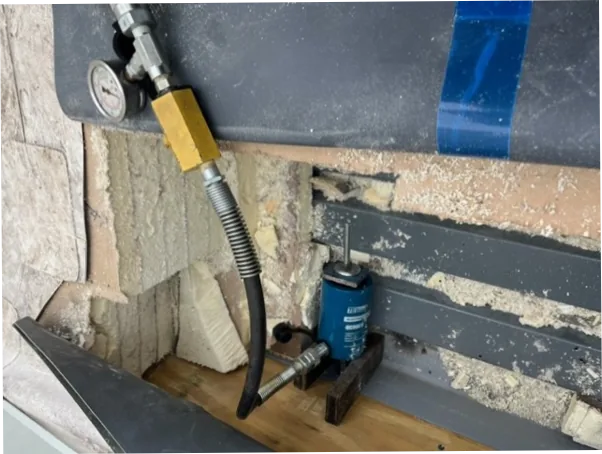
When an anchor bolt fails a pull test, the International Building Code requires all untested anchors of the same type installed by the same trade to be tested until twenty consecutive anchors pass. Then the initial test frequency resumes. The failed anchor must be remediated under the direction of the engineer of record — typically by coring out and replacing with an adhesive anchor rated for cored hole conditions. The failure mode — concrete breakout, pullout, or steel rupture — tells you what went wrong and determines the remediation approach.
The 20-Consecutive-Pass Rule
IBC Section 1705.3 establishes a clear escalation protocol when any anchor fails. All untested anchors of the same type, installed by the same trade, and not previously tested must be tested until twenty consecutive anchors pass. Only then does the initial test frequency resume. Anchors to be tested are selected at random by the special inspector — not by the installer.
This rule exists because a single failure indicates a potential systemic installation problem. If one anchor was installed with a dirty hole or insufficient adhesive, others by the same installer probably were too. The 20-pass threshold provides statistical confidence that the problem was isolated rather than widespread.
What "Same Type, Same Trade" Means
If a 3/4" Hilti HIT-HY 200 adhesive anchor installed by ABC Contractors fails, you test all untested 3/4" HIT-HY 200 anchors installed by ABC Contractors — not the 1/2" anchors, not a different adhesive product, and not anchors installed by a different crew. The failure protocol is scoped to the specific combination of anchor type and installer.
The Failure Protocol Step by Step
Document the Failure
Record the failure mode, load at failure (or load at which movement was detected), anchor type and size, embedment depth, location on the project, installer, and adhesive product and lot number if applicable. Photograph the failed anchor and surrounding concrete.
Notify the Engineer of Record
The special inspector notifies the EOR and the enforcement agency (building department). The EOR determines the remediation approach for the failed anchor and may modify testing requirements for the remainder of the project.
Expand Testing
All untested anchors of the same type by the same trade must be tested. The special inspector selects anchors at random. Testing continues until 20 consecutive anchors pass without failure.
Remediate the Failed Anchor
The failed anchor is removed and replaced per the EOR's direction. The replacement anchor is tested before acceptance. See Remediation Options below.
Resume Normal Frequency
After 20 consecutive anchors pass, testing returns to the initial frequency specified in the construction documents. If another anchor fails during expanded testing, the count resets to zero.
What the Failure Mode Tells You
The way an anchor fails is diagnostic. Each failure mode points to a different root cause and requires a different remediation approach.
Concrete Cone Breakout
BrittleA cone-shaped section of concrete fractures and separates around the anchor. This means the concrete capacity was exceeded — the anchor was stronger than the concrete holding it. Common causes include insufficient embedment depth, anchor placed too close to an edge, anchor spacing too tight, or concrete that hasn't reached design strength. If concrete is less than 21 days old, adhesive anchors should not have been installed per ACI 318.
Bond / Pullout Failure
BrittleThe anchor slides out of the hole with little or no concrete attached. This is almost always an installation problem, not a product defect. The most common cause is inadequate hole cleaning — dust and debris create a barrier that prevents the adhesive from bonding to the concrete substrate. Other causes include wet or water-filled holes, expired or improperly stored adhesive, insufficient cure time, and incorrect adhesive volume. Per the Hilti Q&A platform, if an adhesive anchor comes out clean with no dust attached, the installer likely failed to clean the hole before injecting the adhesive.
Steel Rupture
Ductile · PreferredThe bolt itself fractures under load. This is the preferred failure mode because it means the installation held — the concrete and bond were both stronger than the steel. Steel rupture is a ductile failure that gives visible warning before collapse (the bolt stretches before breaking). This failure mode typically means the anchor was properly installed but the proof load exceeded the steel capacity, which may indicate the wrong bolt grade or diameter was specified for the design load.
The Most Common Causes of Anchor Pull Test Failure
Based on manufacturer technical bulletins, trade forum discussions, and field testing experience, these are the most frequent reasons anchors fail pull tests — ranked by how often they occur in the field.
1. Inadequate Hole Cleaning
The single most common cause. The IBC-required cleaning protocol is blow-brush-blow-brush-blow (compressed air, wire brush, repeat). Skipping steps or rushing through the process leaves concrete dust on the hole walls that prevents adhesive bonding. Simpson Strong-Tie engineering content specifically notes that improperly cleaned holes lead to capacities lower than published values. Field reports on Eng-Tips document failures at as little as one-twentieth of allowable capacity due to poor hole cleaning alone.
2. Insufficient Cure Time
Adhesive anchors require specific cure times that vary by temperature. Hilti HIT-RE 500 V3 cure times range from 20 minutes at 104°F to 24 hours at 23°F. Loading or testing an anchor before full cure is achieved produces artificially low bond strength. In the Southeast summer, concrete surface temperatures can exceed adhesive temperature limits entirely.
3. Wet or Water-Filled Holes
Not all adhesive products are rated for wet conditions. Installing a dry-hole-only adhesive in a hole with standing water or condensation compromises the bond. Check the ICC-ES Evaluation Report (ESR) for the specific product to confirm wet-hole approval.
4. Incorrect Embedment Depth
A bolt that doesn't reach the specified embedment depth has less bond area and a shallower breakout cone — both reduce capacity. This error is particularly dangerous because it may not be visible after installation and is easier to detect with an unconfined test setup.
5. Concrete Not at Design Strength
ACI 318 requires concrete to be at least 21 days old before installing adhesive anchors. Testing anchors in concrete that hasn't reached f'c produces breakout failures at loads below what the design calculations predict.
6. Wrong Product for the Application
Using an adhesive not rated for the specific conditions — cracked concrete, overhead installation, sustained tension, seismic loading, or fire exposure — can result in bond failure even with perfect installation technique. Always verify the ICC-ES ESR covers the actual field conditions.
Remediation Options
The remediation of a failed anchor is determined by the engineer of record. The EOR evaluates the failure mode, the structural implications, and the available options for the specific project conditions. Common remediation approaches include the following.
Core Out & Replace
The most common approach. Core drill out the failed anchor and surrounding concrete, then install a new adhesive anchor in the cored hole. The replacement adhesive must be specifically rated for cored hole conditions because core-drilled holes have smooth sidewalls that standard adhesives cannot bond to properly. Hilti HIT-RE 500 V3 with the TE-YRT roughening tool is one product qualified for this application per ICC-ES ESR-3814.
Relocate the Anchor
Install a replacement anchor in a new location adjacent to the failed one. The new location must meet minimum edge distance and anchor spacing requirements per ACI 318 Chapter 17. The base plate or connection may need to be modified to accommodate the new anchor position. The EOR must verify that the abandoned hole does not affect the capacity of the new anchor.
Redesign the Connection
If multiple anchors fail or if the failure indicates a systemic design issue (insufficient embedment, inadequate edge distance, concrete below design strength), the EOR may redesign the anchor layout entirely — specifying different bolt sizes, deeper embedments, additional anchors, or supplementary reinforcement.
Critical: Cored Hole Adhesive Requirements
Core-drilled holes produce smooth, polished sidewalls that standard adhesives cannot mechanically interlock with. Using a product not rated for cored holes in a cored hole will produce another failure. Always verify the ESR covers cored hole installation — and follow any additional hole roughening requirements specified in the ESR.
Code References
IBC 2024 Section 1705.3
If any anchor fails testing, all untested anchors of the same type installed by the same trade shall be tested until twenty consecutive anchors pass, then resume the initial test frequency. Anchors to be tested shall be selected at random by the special inspector.
ASTM E3121/E3121M-17
Field testing standard for post-installed anchors. Defines proof load and ultimate load test procedures, acceptance criteria, and documentation requirements for both confined and unconfined test configurations.
ACI 318 Chapter 17
Anchor design provisions defining five failure modes, breakout cone geometry (1.5 × hef), and the requirement that concrete be at least 21 days old before adhesive anchor installation.
ICC-ES AC308
Acceptance criteria for post-installed adhesive anchors. Specifies proof load limits: lesser of 67% of nominal strength or 80% of steel yield. Defines remedial action requirements in the event of failure.
Frequently Asked Questions
Had an Anchor Failure? We Can Help.
We perform both remediation testing and expanded pull testing across the Southeast. Calibrated Enerpac equipment, IBC-compliant procedures, full documentation for your inspector and engineer of record.
Request a Quote Call (404) 860-1288